Thanks to Marvel films and comics, many people think of Loki as Thor’s brother. Search engines are full of the question, and the answer depends entirely on which Loki you mean. In the Norse sources, Loki is not Thor’s brother at all. In Marvel stories, he is Thor’s adopted brother. This post explains both versions and where the confusion comes from.
The short answer
In Norse mythology, Loki is not related to Thor by blood or adoption. He is the son of a giant, he lives among the gods, and he is described as the sworn blood-brother of Odin, Thor’s father. Loki and Thor are travelling companions in several myths, but they are not siblings.
In Marvel comics and films, Loki is the son of the frost giant king Laufey. He is adopted by Odin as a baby and raised alongside Thor in Asgard. That makes him Thor’s adopted brother in the Marvel version.
Loki’s family in the myths
According to Snorri Sturluson’s Prose Edda, Loki’s father is the giant Fárbauti and his mother is Laufey, also called Nál. Interestingly, Marvel kept the name Laufey but changed the character from Loki’s mother to his father. Loki’s brothers in the sources are Helblindi and Býleistr, about whom almost nothing is known.
Loki’s wife is the goddess Sigyn, and they have a son named Váli or Narfi, depending on the source. With the giantess Angrboða, Loki fathers three monsters: the wolf Fenrir, the world serpent Jörmungandr, and Hel, the ruler of the dead. In another story, Loki himself takes the shape of a mare and gives birth to Sleipnir, Odin’s eight-legged horse.
Blood-brother of Odin
The key evidence for Loki’s relationship with the gods comes from the Eddic poem Lokasenna, in which Loki insults all the gods at a feast. At one point he reminds Odin that “in days of old” they mixed their blood together, and that Odin promised never to drink ale unless it was brought to both of them. This kind of sworn brotherhood, sometimes called fóstbræðralag, was a serious bond in Norse society, and it helps explain why the gods tolerate Loki for so long despite his behaviour.
This means Loki is something like an uncle figure to Thor in the mythological family, though the sources never use that word.
Loki and Thor as companions
Several myths show Loki and Thor travelling together:
- In Þrymskviða, Loki helps Thor recover his stolen hammer, and dresses as a bridesmaid while Thor poses as the bride Freyja.
- In Snorri’s account of the journey to Útgarða-Loki, Loki goes along and loses an eating contest against a figure who turns out to be fire itself.
- In the story of the giant Geirröðr, Loki is captured and forced to lure Thor to the giant’s home without his hammer.
- In the story of Sif’s hair, Loki’s prank leads to the creation of Thor’s hammer.
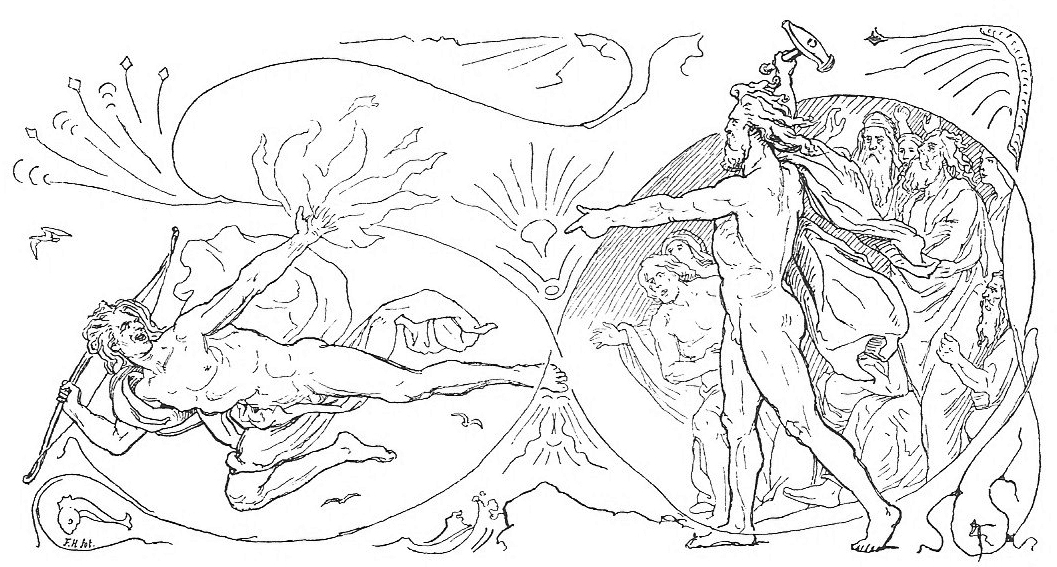
Their relationship is mixed. Thor often threatens Loki with violence when Loki causes trouble, and in Lokasenna it is Thor’s arrival that finally makes Loki leave the hall. The scene shown in the illustration in this post, Loki leaving the hall and threatening the gods with fire, comes from the end of that poem.
Loki’s punishment
After Loki arranges the death of Baldr, the gods hunt him down. In Snorri’s account he hides as a salmon, and Thor catches him with his bare hands, which, Snorri says, is why salmon have narrow tails. The gods bind Loki under the earth with a serpent dripping venom on his face, while Sigyn holds a bowl to catch it. When she turns away to empty the bowl, the venom hits him, and his struggles cause earthquakes. At Ragnarök, Loki breaks free and fights against the gods.
Where the brother idea comes from
Marvel’s version of Loki first appeared in Journey into Mystery #85 in 1962. The writers made him Thor’s adopted brother, which gave the character a clear motive of jealousy and rivalry. This was a creative choice to fit the superhero format, where a villain with a personal connection to the hero makes for strong stories. Over time Marvel developed the character into an anti-hero, and the films made him one of the franchise’s most popular figures.
There is a small amount of support for a closer relationship in the mythology, since Loki is Odin’s sworn brother and lives among Odin’s family. But nothing in the sources describes him as a son of Odin or a brother of Thor.
Is Loki a god or a giant?
Loki’s status is unclear in the sources. By birth he is a giant, the son of Fárbauti. But Snorri counts him among the Æsir, the gods, and he lives in Asgard. Snorri describes him as handsome but evil-minded and unpredictable. Scholars have argued for a long time about whether Loki was ever worshipped. There is very little evidence of a cult, no place names clearly connected to him, and he appears mainly as a character in stories rather than a god people prayed to.
The takeaway
If someone asks whether Loki is Thor’s brother, the most accurate answer is: in Marvel, yes, by adoption; in Norse mythology, no. In the myths Loki is a giant-born member of the gods’ circle, Odin’s sworn blood-brother, a companion of Thor, the father of monsters, and in the end an enemy of the gods at Ragnarök.
Reading about Loki in the sources
The best places to meet the mythological Loki are Lokasenna and Þrymskviða in the Poetic Edda, and the Gylfaginning and Skáldskaparmál sections of Snorri’s Prose Edda. Reading them shows a character who is far more ambiguous than either a simple villain or a loyal brother. He solves problems the gods cannot solve, but he also causes many of those problems in the first place. Scholars have compared him to trickster figures in other cultures, while also noting features that are unique to the Norse material. Public-domain translations are freely available, and modern editions add helpful notes.
Discover more from Thor Stuff
Subscribe to get the latest posts sent to your email.