Small hammer-shaped pendants are among the most distinctive objects from the Viking age. Archaeologists have found them in graves, hoards and settlements across Scandinavia and beyond. They are usually interpreted as amulets connected to Thor. This post looks at what the finds are, where they come from, how they were made, and what they may have meant to the people who wore them.
How many have been found?
Estimates vary as new finds are made, but researchers have catalogued well over a thousand hammer-shaped pendants and related objects from the Viking age. They come mainly from Sweden, Denmark and Norway, with smaller numbers from Iceland, Finland, the Baltic region, Russia, Britain and Ireland. Metal-detecting by the public has added many finds in recent decades, especially in Denmark and England, where finds are recorded through official schemes.
Materials and styles
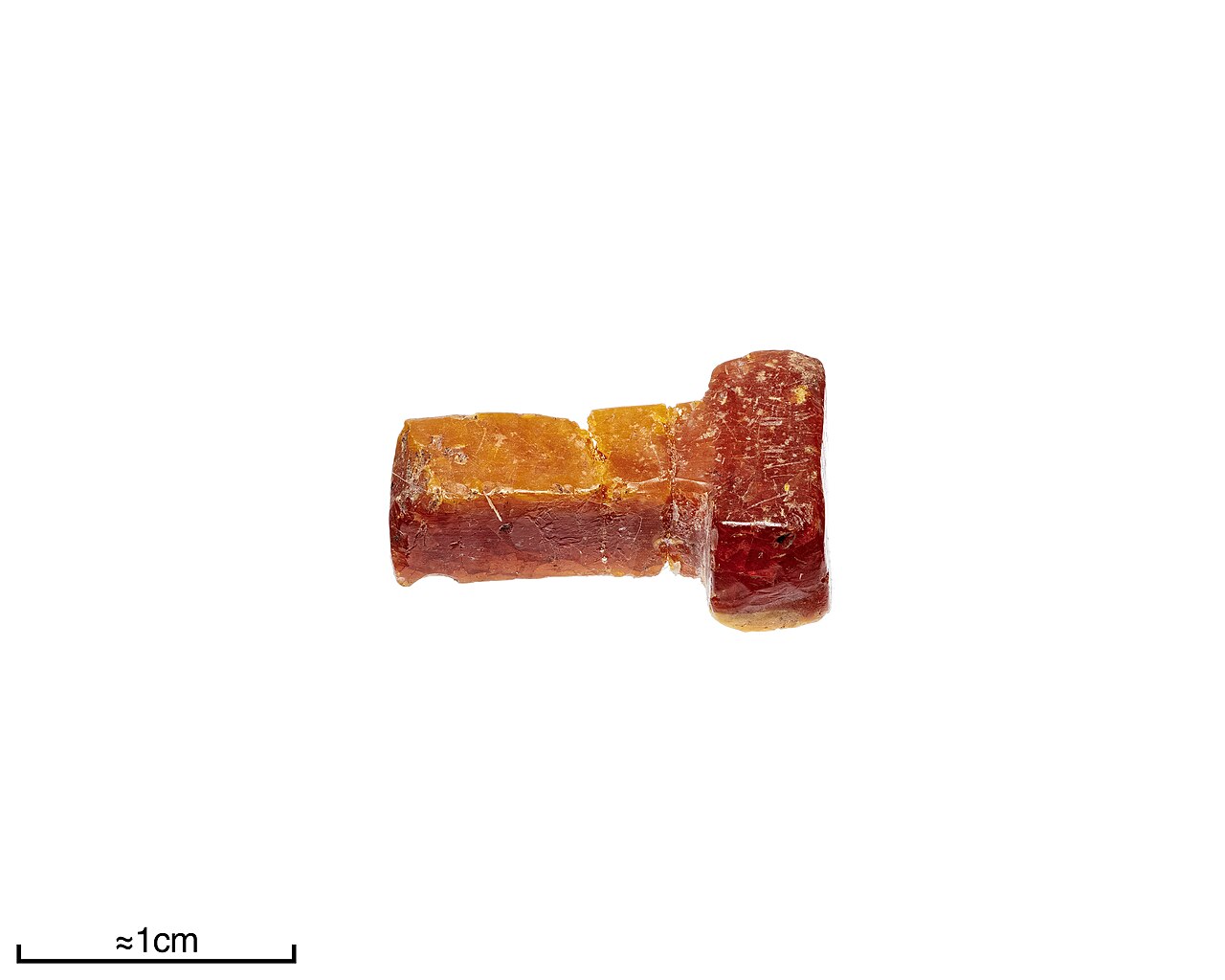
Hammer amulets were made from many materials, including silver, bronze, iron, amber, bone and occasionally gold. They range from simple, plain shapes to elaborately decorated pieces.
Some well-known examples include:
- The Skåne pendant, a silver hammer with filigree decoration and a stylised face at the top, found in southern Sweden.
- The Erikstorp pendant from Östergötland, Sweden, a silver hammer with a bird-like head and a looped chain.
- The Rømersdal pendant from Denmark, an ornate silver piece with granulation.
- Small amber hammers, like the one from the Swedish History Museum pictured in this post, which were carved in a simpler shape.
Iron hammer rings are another category. These are iron neck rings with small hammer-shaped pendants hanging from them, found mainly in central Sweden and the Åland islands, often in cremation graves. They seem to have had a ritual purpose rather than being everyday jewellery.
Dating the finds
Most hammer pendants date from the 900s and 1000s, though some iron hammer rings are earlier, from the 800s. This dating is significant because it overlaps with the period when Christianity was spreading in Scandinavia. Denmark’s King Harald Bluetooth claimed to have made the Danes Christian around 965, Norway was largely Christianised in the late 900s and early 1000s, and Sweden more gradually over the 1000s and 1100s.
Hammer and cross
Because of this timing, many scholars think wearing a hammer became more popular partly as a response to the Christian cross. As Christians wore crosses as a sign of faith, followers of the old religion may have adopted the hammer as a comparable symbol. This interpretation is widespread, but not every scholar accepts it fully, since hammer imagery also appears earlier.
One of the best-known objects in this debate is a soapstone casting mould found at Trendgården in Jutland, Denmark. It has cavities for casting two crosses and one hammer at the same time. The craftsman who used it was apparently happy to supply both kinds of customer. Some pendants, like one from Foss in Iceland, also seem to combine features of both the cross and the hammer.
What did the amulets mean?
The written sources give some clues. The myths show Mjölnir being used not only as a weapon but also to bless, for example at weddings and funerals. Runestones include phrases like “may Thor hallow these runes”. Together these suggest that a hammer symbol could be used for protection and blessing.
Finds in graves suggest that hammer amulets were buried with both men and women. Their exact meaning probably varied: a sign of religious identity, a good-luck charm, a protective object, or simply a fashionable piece of jewellery. It is likely that different people wore them for different reasons.
Hammer shapes on runestones and other objects
The hammer motif appears beyond pendants. Runestones such as the Laughterstone in Denmark and stones in Södermanland, Sweden, carry carved hammers. Some miniature hammers were placed in graves, possibly as offerings. The Eyrarland figurine from Iceland, a small bronze statuette of a seated man holding his beard, is often identified as Thor, with the beard shaped like a hammer.
Studying amulets responsibly
Interpreting these objects involves caution. Not every T-shaped pendant is necessarily a Thor’s hammer, and some objects have been reinterpreted over time. Archaeologists consider the context of each find, the grave or hoard it was found in, the other objects with it, and the date, before drawing conclusions.
The museums that hold these objects, including the Swedish History Museum in Stockholm and the National Museum of Denmark in Copenhagen, increasingly make photographs of their collections freely available online. These resources are a good way to see the range of designs without relying on modern reproductions.
Modern reproductions
Hammer pendants are widely produced today as jewellery. Some are careful replicas of specific finds, while others are modern designs. Anyone interested in historically accurate pieces can look for reproductions that name the original find and museum. Comparing a reproduction with photographs of the original is a simple way to judge its accuracy.
Why these small objects matter
Hammer amulets are some of the clearest physical evidence for the worship of Thor among ordinary people. Written sources were mainly produced by elites and recorded later by Christian authors. The amulets, by contrast, are objects that real people chose to wear and bury with their dead, which makes them an important window into everyday belief in the Viking age.
Seeing the originals
Many of the finds mentioned here can be seen in museum displays or in online collection databases. The Swedish History Museum in Stockholm holds the Skåne and Erikstorp pendants and many smaller hammers. The National Museum of Denmark in Copenhagen holds Danish finds, including the Trendgården mould. In England, finds reported through the Portable Antiquities Scheme are recorded in a public online database with photographs and descriptions.
Discover more from Thor Stuff
Subscribe to get the latest posts sent to your email.