
Ask someone to picture Thor and they might imagine a blond hero with a clean jaw. Ask a medieval Icelander and the answer would probably have been a big man with a red beard. This post looks at what the sources say about Thor’s hair and beard, how artists have shown him over the centuries, and how the modern blond image took hold.
What the old sources say
The clearest descriptions of Thor’s red beard come from Icelandic and Norwegian texts written in the 1200s and 1300s. In the saga of Olaf Tryggvason, the Christian king Olaf meets a mysterious red-bearded man who tells stories about Norway’s past and then disappears. The story suggests the man was Thor. Another episode in the same tradition has a man pray to “Red-beard” for good winds.
The Eddic poem Þrymskviða does not mention the beard’s colour, but it does mention Thor’s beard shaking in anger when he discovers his hammer is missing. In the same poem, people comment on the bride’s “fierce eyes” when Thor is disguised as Freyja. Snorri Sturluson’s Prose Edda mentions that Thor blows into his beard to raise a storm or wind, again connecting the beard with his power over weather.
Older sources tend to concentrate on Thor’s strength, anger and appetite rather than his looks, so the colour is not stated everywhere. But where a colour is given in medieval texts, it is red.
Why red?
Scholars have suggested several reasons for the red beard. One is the link with fire and lightning. A thunder god with a fiery-coloured beard makes visual sense. Another explanation points to the practical reality of Scandinavian populations, where red hair is relatively common. There may also be a symbolic link with strength and anger in medieval Norse culture.
There is no firm evidence about whether Viking-age people already imagined Thor as red-haired, since the descriptions all come from later writers. Small figurines and carvings from the period do not preserve colours. The Eyrarland statue found in Iceland, a small bronze figure often identified as Thor, shows a seated man gripping his beard, which seems to end in a hammer shape. That suggests the beard was an important part of his image, whatever its colour.
Thor in early modern art
Manuscripts of the Eddas produced in Iceland in the 1600s and 1700s include illustrations of the gods. A manuscript known as SÁM 66, made by Jakob Sigurðsson in the 1760s, shows Thor with a hammer and a beard in a lively folk style. These images are not historical evidence for how Viking-age people saw him, but they show the continuing tradition in Iceland.
The Romantic era
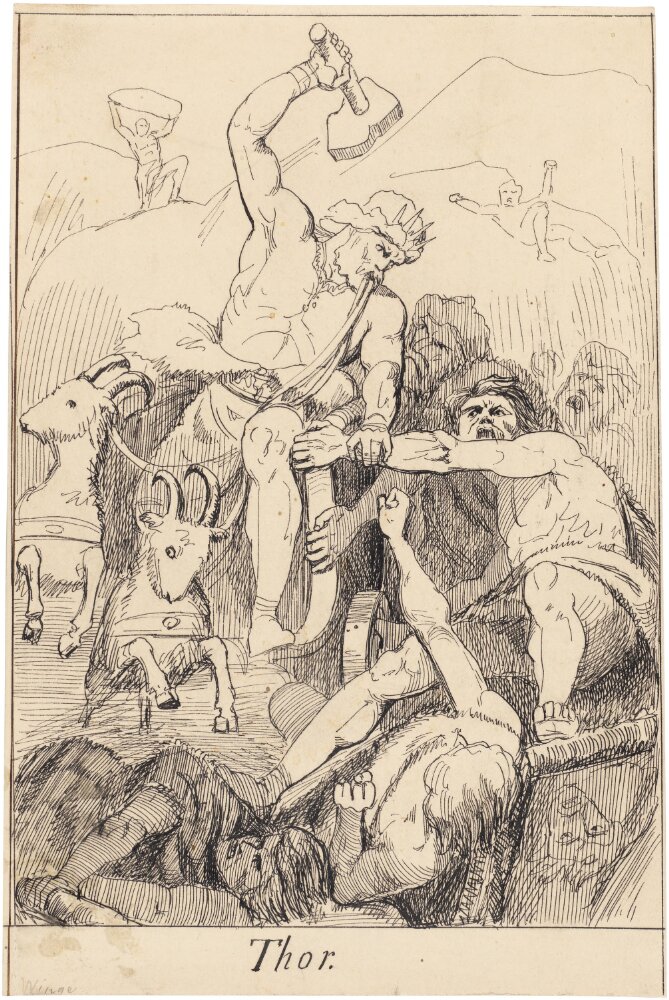
The 1800s brought a wave of interest in Norse mythology across Scandinavia, Germany and Britain. Painters and illustrators such as Mårten Eskil Winge in Sweden, Lorenz Frølich in Denmark, and later artists in Germany and Britain produced dramatic images of Thor. Winge’s painting Thor’s Fight with the Giants (1872) shows him as a powerful figure with a red beard and flying hair in a chariot pulled by goats. His sketch of Thor is reproduced in this post.
Many Romantic artists shaped Thor in the style of classical sculpture, with idealised muscles and noble features. In Germany the related god Donar was sometimes shown in a more Wagnerian style. Through these images, Thor gradually became more of a heroic figure and less of the rough, comic, red-bearded giant-killer of the Icelandic sagas.
How the blond Thor arrived
When Stan Lee, Larry Lieber and Jack Kirby created Marvel’s Thor in 1962, they gave him long blond hair and no beard. Kirby’s design drew on the heroic Romantic tradition, Wagner’s operas and the visual language of earlier comics, where blond hair often signalled the hero. The design helped make Thor fit the superhero mould alongside characters such as Superman and Captain America.
When the Thor films appeared from 2011 onwards, they kept the blond hair, added a short beard, and made this the dominant image of Thor in popular culture. Some recent comics and other media have given Thor a fuller beard, and video games such as the 2018 God of War show Thor as a large, red-bearded figure closer to the sagas.
Does it matter?
For most purposes the colour of a fictional or mythological figure’s beard is a small detail. But it is a useful example of how images change over time. The modern idea of Thor has been shaped by several layers: the medieval Icelandic texts, early modern manuscript art, 19th-century Romanticism, 20th-century comics and 21st-century film. Each layer added something and dropped something else.
Recognising these layers can make it easier to read the original sources without the modern image getting in the way. When the sagas describe a red-bearded stranger who appears to a king and vanishes, it helps to forget the film character and picture the older Thor instead.
Seeing the older images
Many of the 19th-century works mentioned here are in public collections. Winge’s Thor’s Fight with the Giants hangs in the Nationalmuseum in Stockholm, and digitised versions of it and of Frølich’s Edda illustrations are available on Wikimedia Commons in the public domain. The SÁM 66 manuscript is held by the Árni Magnússon Institute in Reykjavík, and images from it are also freely available online.
A note on the Eyrarland figure
The small bronze Eyrarland statue, found near Akureyri in Iceland and now in the National Museum of Iceland, is only about 6.7 cm tall and dates to around the year 1000. It is often called the Eyrarland Thor, though not every scholar agrees that it shows Thor at all. Some have suggested it could be a gaming piece or a depiction of another figure. If it is Thor, it is one of the very few images that may come from people who actually worshipped him, and its emphasis on the beard fits well with the later written descriptions.
Discover more from Thor Stuff
Subscribe to get the latest posts sent to your email.