Marvel’s Thor first appeared in the comic Journey into Mystery #83 in 1962, created by Stan Lee, Larry Lieber and Jack Kirby. Since then the character has become, for many people, the main version of Thor they know. The comic and film character borrows names and ideas from Norse mythology but changes a great deal. This post compares the two in ten areas, without judging either. One is a religious and literary tradition, the other is modern entertainment.
1. Origins and purpose
The Norse Thor was a god worshipped by real communities, with a place in their religion and daily life. Amulets, place names and runic inscriptions show that people called on him for protection. Marvel’s Thor is a fictional superhero created for a commercial comic book series, designed to fit into a shared universe of characters. That basic difference shapes everything else.
2. Appearance
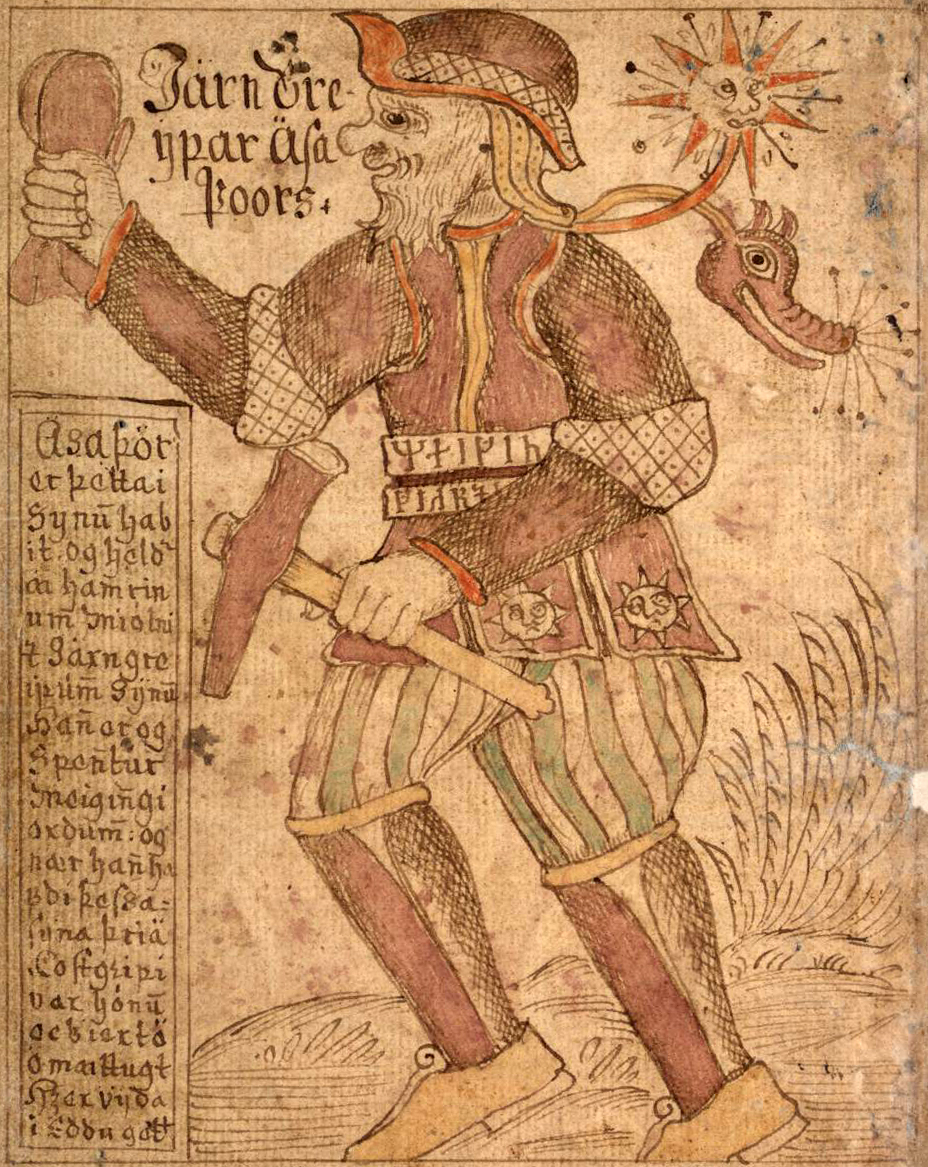
In Icelandic sources, Thor is typically described as large, fierce and red-bearded, and the 18th-century Icelandic manuscript illustration in this post shows him that way. Marvel’s Thor is blond, and in the films he was for a long time clean-shaven or lightly bearded. The blond look reflects 19th-century Romantic art and mid-20th-century ideas of the heroic Nordic warrior more than the medieval sources. Our separate post looks at the red beard in more detail.
3. The hammer
In the myths, Mjölnir is a short-handled hammer made by the dwarves Brokkr and Eitri. Thor needs iron gloves to hold it, and its main features are that it never misses and always returns. Marvel’s hammer keeps the name but has a longer handle and a leather strap, and it adds an enchantment: only someone “worthy” can lift it. That inscription and the worthiness test are Marvel inventions with no source in Norse literature.
4. Family
Both versions make Thor the son of Odin. In the myths his mother is Jörð, the earth, while Marvel has used various mothers, including Frigga, who in the myths is Odin’s wife but not Thor’s mother. The mythological Thor is married to Sif and has three children: Magni, Móði and Þrúðr. Marvel’s Sif is a warrior and companion rather than a wife, and Thor’s children appear only occasionally in comics.
5. Loki
This is perhaps the biggest change. Marvel’s Loki is Thor’s adopted brother, a frost giant child taken in by Odin. In the myths Loki is not related to Thor at all. He is the son of the giant Fárbauti and is described as Odin’s sworn blood-brother. The mythological Loki travels with Thor, gets him into and out of trouble, and is eventually punished for his part in the death of Baldr. See our post on whether Loki is Thor’s brother for more.
6. Personality
The Norse Thor is short-tempered, hungry, brave and sometimes comic, as in the poem where he disguises himself as a bride to recover his hammer. He is not especially clever and is easily fooled by giants such as Útgarða-Loki. Marvel’s Thor began as a noble, formal hero who spoke in pseudo-Shakespearean English. More recent films made him funnier and more self-mocking, which is arguably closer in tone to some of the myths.
7. Secret identity
Marvel’s early comics gave Thor a human alter ego, a doctor named Donald Blake, who could transform into Thor by striking a walking stick on the ground. Later stories changed this repeatedly. Nothing like this exists in the Norse sources. Thor travels in disguise in some myths, but he never lives as a human.
8. Asgard and the nine realms
Both versions include Asgard and other worlds connected by the world tree Yggdrasil. In the myths, the arrangement of the nine worlds is vague and the sources do not list them consistently. Marvel presents Asgard as an advanced alien civilisation, with technology described as magic, connected to other realms by the Bifrost bridge. The mythological Bifröst is a burning rainbow bridge between Midgard and Asgard, guarded by Heimdallr, and it breaks at Ragnarök.
9. Enemies
The mythological Thor’s enemies are mostly the jötnar, the giants, and above all the world serpent Jörmungandr. Marvel’s Thor fights a much wider range of villains, many of them invented, including the Enchantress, the Destroyer and Gorr. Frost giants appear in both, but in very different forms. Marvel’s Thor has also faced Jörmungandr in some storylines, a nod to the myths.
10. Ragnarök and death
In the myths, Thor dies at Ragnarök after killing Jörmungandr, walking nine steps before falling from its poison. His sons survive to inherit his hammer. In Marvel stories, “Ragnarok” has been used for several storylines and a 2017 film, but the details have little to do with the Norse version, and as is usual in superhero fiction, Thor has never stayed dead for long.
Why the differences matter
None of this is a criticism of the comics or films, which never claimed to be faithful retellings. But the differences matter when people use the movies as a guide to the mythology, or the other way round. A student writing about Norse religion, a visitor to a Viking museum, or a reader picking up the Eddas for the first time will find a very different figure from the screen character.
Where to start with the original
For anyone who knows the films and wants to meet the older Thor, three good starting points are:
- Gylfaginning in Snorri Sturluson’s Prose Edda, which tells many Thor stories in prose.
- Þrymskviða, the comic poem about the theft of the hammer.
- Hymiskviða, the poem about the fishing trip with the giant Hymir.
All of these are available in free public-domain translations and in modern editions. Reading them alongside the films can be an enjoyable way to see how much, and how little, a modern adaptation keeps.
Discover more from Thor Stuff
Subscribe to get the latest posts sent to your email.