Ragnarök is the great final battle of Norse mythology, the event in which much of the world and most of the gods are destroyed. Thor has a clearly defined part in it. This post looks at what the key source, the poem Völuspá, says about his fate, how Snorri Sturluson expanded on it, and what happens afterwards.
What Ragnarök means
The Old Norse word Ragnarök is usually translated as “fate of the gods”. A related form, Ragnarökkr, used by Snorri and in one Eddic poem, means “twilight of the gods”, which is the source of the German Götterdämmerung, the title of Richard Wagner’s opera. Both forms point to the same event: the end of the current world order.
The main sources
The most important source is Völuspá, “the prophecy of the seeress”, the first poem in the Codex Regius manuscript of the Poetic Edda. In it, a seeress tells Odin about the creation of the world and its future destruction. Other Eddic poems, especially Vafþrúðnismál, add details, and Snorri combines all of these in the Gylfaginning section of his Prose Edda to produce the most complete narrative.
The signs before the end
According to the sources, Ragnarök is preceded by a series of disasters. Baldr, the beloved son of Odin, is killed, and Loki is bound as punishment. A terrible winter called Fimbulvetr lasts three years without a summer. Brothers kill each other, and moral order collapses. The wolves that chase the sun and moon catch and swallow them, the stars disappear, and the earth shakes.
Loki and his monstrous children break free. The wolf Fenrir runs loose with his jaws gaping from earth to sky. Jörmungandr rises from the sea, flooding the land and spraying poison. The fire giant Surtr leads the sons of Muspell from the south, and the rainbow bridge Bifröst breaks under them. The god Heimdallr blows the Gjallarhorn to call the gods to battle.
Thor’s final fight
In the battle, each of the major gods faces a particular opponent. Odin fights Fenrir and is swallowed by the wolf. Freyr fights Surtr and dies because he gave away his sword long ago. Týr and the hound Garmr kill each other, as do Heimdallr and Loki.
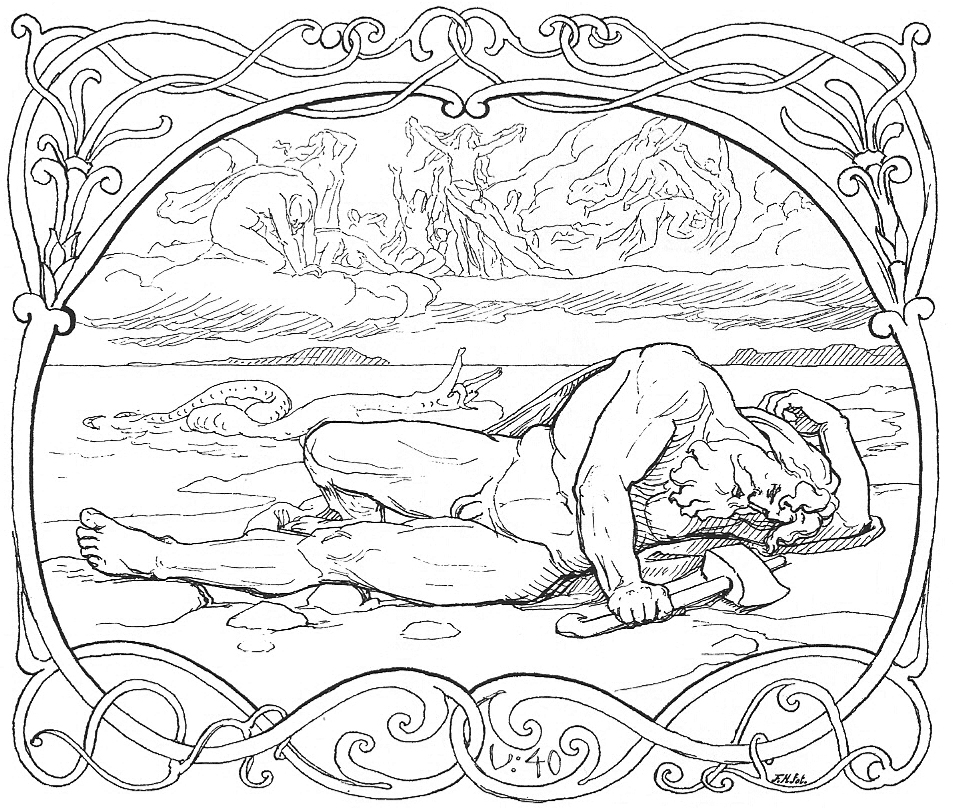
Thor faces Jörmungandr, his old enemy from the fishing trip with Hymir. Völuspá describes the meeting in a few lines. Thor, “the son of Hlóðyn”, goes out to fight the serpent and kills it in his anger. Then he walks nine steps away from the serpent before falling dead, poisoned by its venom.
Snorri’s version is similar. He says that Thor will win great fame by killing the serpent, but will step back nine paces and fall dead from the poison the serpent spits at him. The image of nine steps is the most memorable detail of Thor’s death, and the number nine appears often in Norse myth and ritual.
Why Thor dies
The story does not present Thor’s death as a failure. He fulfils his role as protector to the very end by killing the most dangerous of the monsters threatening the world. The meeting is also the conclusion of the story arc that runs through the other serpent myths, where the outcome is always delayed. At Ragnarök the confrontation is finally settled, and neither survives.
Some scholars have pointed out that Thor’s death, killing his opponent and then dying of its poison, has parallels in other traditions, including the hero Beowulf, who kills a dragon and then dies of his wounds. Whether these parallels reflect shared roots or simply a common storytelling pattern is still debated.
The world after Ragnarök
Ragnarök is not quite the end of everything. After Surtr’s fire burns the world, the earth rises again from the sea, green and fertile. Several gods survive. Odin’s sons Víðarr and Váli, who avenge their father, live on. Baldr and Höðr return from the realm of the dead. Thor’s sons, Móði and Magni, survive and inherit Mjölnir, according to Vafþrúðnismál.
Two humans, Líf and Lífþrasir, survive by hiding in a wood, sometimes linked to the world tree Yggdrasil, and repopulate the world. The surviving gods find the golden game pieces that belonged to the old gods lying in the grass. In this way the myth contains both destruction and renewal.
Possible Christian influence
Because Völuspá and Snorri’s work were recorded in a Christian society, scholars have long discussed whether the idea of a final battle followed by a renewed world was influenced by Christian ideas of the apocalypse and the new Jerusalem. Some details, such as a mighty ruler who comes from above in one stanza of the poem, look particularly suspicious to some readers. Others argue that the core of the story, the gods and monsters destroying each other, is older and fits well with other Indo-European myths. There is no consensus, and most likely the surviving version blends older traditions with later influences.
Ragnarök in art
Ragnarök scenes appear in a few Viking-age carvings. The Thorwald’s Cross on the Isle of Man shows a figure with a raven being attacked by a wolf, usually read as Odin facing Fenrir. The Gosforth Cross in Cumbria includes scenes that are often linked to Ragnarök, including a figure fighting a beast with open jaws. In the 1800s and early 1900s, illustrators such as Lorenz Frølich, whose drawing of Thor and the serpent is reproduced in this post, and W. G. Collingwood created memorable images of the battle that are now in the public domain.
Further reading
Völuspá, Vafþrúðnismál and Gylfaginning are all available in free public-domain translations. For a modern overview, general introductions to Norse mythology by academic authors set out the sources and the scholarly debates in accessible language.
Discover more from Thor Stuff
Subscribe to get the latest posts sent to your email.