
Of all Thor’s adventures, his fishing trip with the giant Hymir was among the most widely known in the Viking age. It is told in the Poetic Edda and retold by Snorri Sturluson, and, unusually, it also appears in carved stone in several places across Scandinavia and the British Isles. That makes it one of the few Norse myths that can be traced in both literature and physical monuments.
Who is Jörmungandr?
Jörmungandr, also called the Midgard Serpent or the World Serpent, is one of the three monstrous children of Loki and the giantess Angrboða. The others are the wolf Fenrir and Hel, who rules the realm of the dead. According to Snorri, Odin threw the serpent into the ocean that surrounds Midgard, the human world. There it grew so large that it encircles the whole world and bites its own tail.
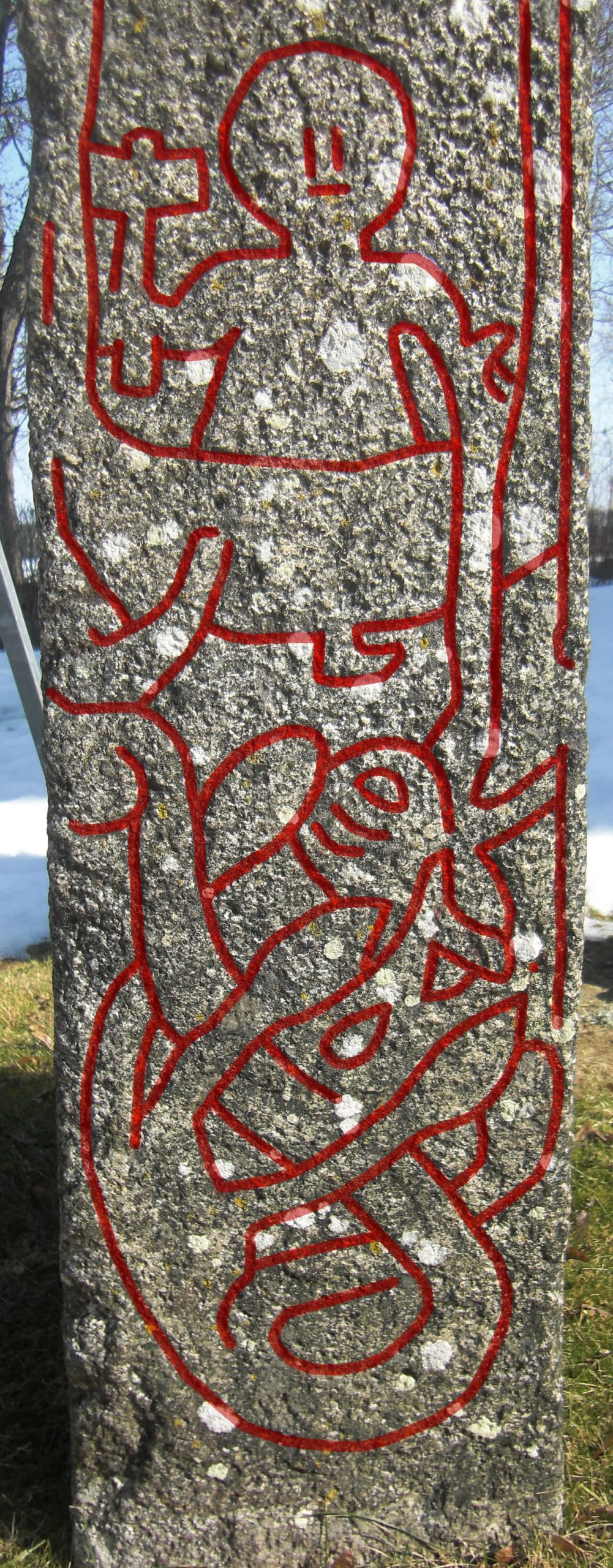
Thor and the serpent are destined enemies. They meet three times in the mythology: once when Thor is tricked into trying to lift it disguised as a cat in the hall of Útgarða-Loki, once on the fishing trip, and finally at Ragnarök, when they kill each other.
The story in the Poetic Edda
The poem Hymiskviða gives the fullest poetic version. The gods want to hold a feast with the sea giant Ægir, but he needs a cauldron big enough to brew ale for all of them. The god Týr says that his kinsman, the giant Hymir, owns a cauldron a mile deep. Thor and Týr travel to Hymir’s hall to get it.
At dinner Thor eats two of Hymir’s oxen by himself, so the next day the giant says they will have to catch their food. Thor offers to row out with him. When Hymir tells him to find his own bait, Thor tears the head off Hymir’s best ox. Out at sea Hymir catches two whales, but Thor baits his line with the ox head, and the serpent takes it.
Snorri’s retelling
Snorri’s version in the Gylfaginning section of the Prose Edda is more dramatic and adds memorable details. Thor travels disguised as a young man and stays with Hymir overnight. When they row out, Thor keeps rowing further than Hymir wants to go, past the usual fishing grounds, until the giant is frightened.
When the serpent bites, Thor pulls so hard that his feet go through the bottom of the boat and he braces them on the seabed. He hauls the serpent’s head up to the side of the boat and the two glare at each other while the serpent spits poison. Thor raises his hammer, but Hymir, terrified, cuts the line and the serpent sinks back into the sea. Thor throws his hammer after it, and Snorri says that some people believe he struck off its head, but that the truth is the serpent still lives. Thor then knocks Hymir overboard and wades back to shore.
The carved stones
What makes this myth especially interesting is that it seems to have been carved in stone by people who knew the story well before Snorri wrote it down. At least four monuments are usually linked to it:
- The Altuna runestone in Uppland, Sweden, from the 1000s, shows a figure in a boat with a hammer raised and a line going down to a serpent. A foot appears to go through the bottom of the boat, matching Snorri’s detail. It is the stone pictured in this post.
- The Hørdum stone in Thy, Denmark, shows two figures in a boat, one with a foot pushed through the hull.
- The Gosforth fishing stone in Cumbria, England, shows figures in a boat with an ox-head bait and fish below.
- A carved stone from Ardre on Gotland is also sometimes interpreted as showing the scene.
These carvings show that the main elements of the story, including the foot through the boat, were part of Viking-age tradition and not later inventions.
Did Thor kill the serpent?
Interestingly, the sources disagree on the outcome. Hymiskviða seems to suggest a violent blow that shakes the earth, after which the serpent sinks. Some skaldic poems, such as fragments attributed to Bragi Boddason and Úlfr Uggason, describe the encounter without clearly saying who won. Snorri makes a point of saying that the serpent survived, which keeps his account consistent with the prophecy that Thor and the serpent will fight again at Ragnarök.
Some scholars think there may once have been a version in which Thor did kill the serpent on the fishing trip, and that Snorri adjusted it to fit his overall timeline. This cannot be proved either way, but it is a good example of how a single storyteller’s choices shape the version of a myth most people know.
What the myth might mean
Interpretations vary. One reading treats the story as a straightforward contest between the god of order and the monster of chaos, with the outcome deliberately left open because the final battle is still to come. Another focuses on Thor’s role as a protector of seafarers: a god who can face the dangers of the deep ocean. The prominence of fishing and boats in the story also fits the importance of the sea in Scandinavian life.
Christian-era writers and artists may have found the story useful too. At Gosforth, the fishing scene sits in a churchyard alongside Christian imagery, and some scholars suggest it may have been read as a parallel to Christ defeating the Leviathan.
Reading the story yourself
Both Hymiskviða and Gylfaginning are available in several public-domain English translations online, including those by Henry Adams Bellows and Arthur Gilchrist Brodeur, as well as in modern translations. Reading the two versions side by side is a useful way to see how poetry and prose treated the same myth.
Discover more from Thor Stuff
Subscribe to get the latest posts sent to your email.