Thor’s hammer is one of the most recognisable symbols to come out of the Viking age. It appears in the myths as a weapon, in archaeology as a small pendant, and in modern culture on everything from tattoos to logos. This post looks at what the old sources say about the hammer itself, how it was made, and the different jobs it seems to have done in belief and ritual.
The name Mjölnir
The Old Norse name is usually written Mjöllnir or Mjölnir. Its meaning is debated. One common explanation links it to words for grinding or crushing, related to the English “mill” and “meal”, which would make it something like “the crusher”. Another connects it to words for lightning or for something bright, which would fit Thor’s role as a thunder god. Both ideas have supporters, and the uncertainty is a reminder that even familiar names from this period can be hard to pin down.
How the hammer was made
The best-known account of Mjölnir’s creation is in Snorri Sturluson’s Prose Edda, in a section called Skáldskaparmál. The story begins with Loki cutting off the golden hair of Sif, Thor’s wife, as a prank. Thor threatens him, and Loki promises to get replacement hair made of real gold from the dwarves.
Loki goes to a group of dwarves called the sons of Ivaldi, who make the golden hair along with two other treasures: the ship Skíðblaðnir and the spear Gungnir. Loki then bets his own head with two other dwarf brothers, Brokkr and Eitri, that they cannot make three treasures as fine. They make the boar Gullinbursti, the gold ring Draupnir, and finally the hammer.
While Eitri works the forge, Loki turns into a fly and bites Brokkr to distract him from working the bellows. On the third bite, on the eyelid, Brokkr stops pumping for a moment. As a result, the hammer’s handle comes out shorter than intended. Even so, the gods judge Mjölnir the best of all the treasures because it can protect them against the giants.
What Mjölnir can do
In the myths, the hammer has several distinctive qualities:
- It never misses its target and always returns to Thor’s hand after being thrown.
- It can be made small enough to tuck inside Thor’s tunic.
- It is so heavy and hot that Thor needs his iron gloves to hold it, according to Snorri.
- Its blow is enough to kill even the strongest giants.
It is worth noting that the idea of the hammer being liftable only by the “worthy” does not come from the Norse sources. That is a modern addition from comics and films. In the myths, the problem is usually theft, not who can lift it.
The hammer as a tool of blessing
Mjölnir is not only a weapon. Several stories show it being used to bless or consecrate. Thor uses it to bless the bones of his goats so that they come back to life. In Þrymskviða, the giant Þrymr, who has stolen the hammer, orders it to be placed in the lap of the “bride” (actually Thor in disguise) to hallow the marriage. That detail is often read as evidence that hammers were part of real wedding customs. Snorri also tells how Thor hallowed the funeral pyre of the god Baldr with Mjölnir.
Runic inscriptions back this up. Several Danish and Swedish runestones carry phrases like “Þórr vígi” (“may Thor hallow”), sometimes with a carved hammer shape, apparently calling on Thor to protect the monument or the dead person it commemorates.
The theft of the hammer
Þrymskviða, one of the poems of the Poetic Edda, is the main story built around the hammer. Thor wakes up to find Mjölnir gone. Loki discovers that the giant Þrymr has hidden it deep underground and will only return it if the goddess Freyja marries him. Freyja angrily refuses. The god Heimdallr suggests that Thor dress up as a bride instead, with Loki going along as a bridesmaid.
The poem is openly comic. The disguised Thor eats an entire ox, eight salmon and all the delicacies meant for the women, and drinks three barrels of mead, while Loki explains that the “bride” has not eaten for eight days out of excitement. When the hammer is finally brought in to bless the wedding, Thor grabs it and kills the giants in the hall.
Hammer pendants and their meaning
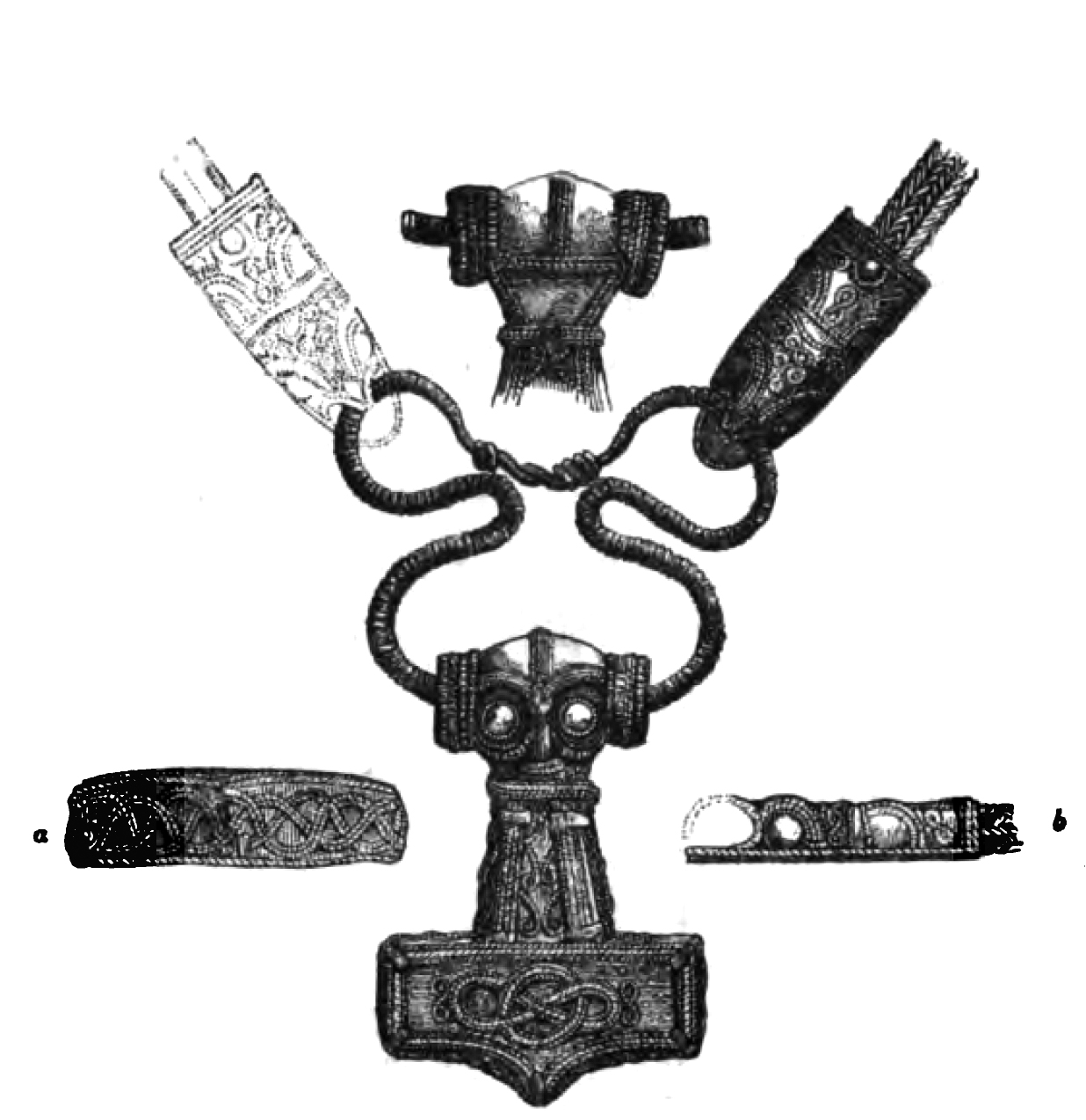
Archaeologists have found well over a thousand small hammer-shaped pendants from Scandinavia and the Baltic area, made from silver, iron, bronze and amber. Some are simple and some are richly decorated, such as the silver examples from Skåne and from Erikstorp in Östergötland, Sweden, the latter pictured in this post in a 19th-century reproduction.
Many of these pendants date from the 900s and 1000s. Because this was the period of Christian conversion in Scandinavia, some researchers think wearing a hammer became a way to show loyalty to the old gods, much as Christians wore crosses. There is even a well-known soapstone mould from Trendgården in Denmark that could cast both crosses and hammers, suggesting that one craftsman supplied customers of both faiths. Our separate post on amulets looks at these finds in more detail.
Mjölnir today
Modern uses of the hammer symbol are very varied. It appears in Scandinavian heritage organisations, in modern pagan movements such as Ásatrú, in heavy metal culture and, of course, in popular entertainment. Most of these uses are harmless, but the symbol has also occasionally been adopted by extremist groups, which is why some modern Norse pagan organisations make a point of stating that their use of the hammer has nothing to do with those views.
For anyone interested in the original meaning, the best starting point is the primary sources: Þrymskviða in the Poetic Edda and the Skáldskaparmál section of the Prose Edda, both of which are available in free public-domain translations as well as modern editions.
Discover more from Thor Stuff
Subscribe to get the latest posts sent to your email.