Thor is the best known of the Norse gods today, but most people meet him first through films and comics. The older Thor, the one worshipped across Scandinavia and the wider Germanic world for centuries, is a different figure. This primer sets out what the surviving sources actually say about him, where those sources come from, and why they need to be read with some care.
Where our knowledge of Thor comes from
Almost everything we know about Thor as a character comes from texts written down in Iceland in the 1200s, roughly two centuries after Iceland formally adopted Christianity around the year 1000. The two most important are the Poetic Edda, a collection of anonymous mythological and heroic poems preserved mainly in a manuscript called the Codex Regius, and the Prose Edda, a handbook on poetry and myth written by the Icelandic scholar and politician Snorri Sturluson around 1220.
These are invaluable sources, but they were recorded by Christian authors looking back at older traditions. Some poems are probably much older than the manuscripts, while Snorri sometimes organised, explained or smoothed over the material to make a tidy system. Historians therefore combine the Eddas with other evidence: skaldic verse composed for Viking-age rulers, place names, runic inscriptions, carved stones, small amulets found in graves and hoards, and short descriptions by outside writers such as Adam of Bremen, who described a temple at Uppsala in the 1070s with a statue of Thor in the place of honour.
Thor’s role: protector of gods and people
In the myths, Thor’s main job is defence. He guards Asgard, the home of the Æsir gods, and Midgard, the world of humans, against the jötnar, the giants who represent chaos and the untamed forces outside the ordered world. Many stories follow the same basic shape: a threat appears, Thor travels east into giant territory, and he returns having killed or humiliated his opponents.
Thor is also closely tied to weather, especially thunder. His name comes from the Proto-Germanic word for thunder, and the same root appears in the Old English Þunor and the Old High German Donar. Farmers and sailors had good reason to care about storms, rain and good weather, which helps explain why Thor seems to have been especially popular among ordinary people rather than only among kings and warriors.
His appearance and possessions
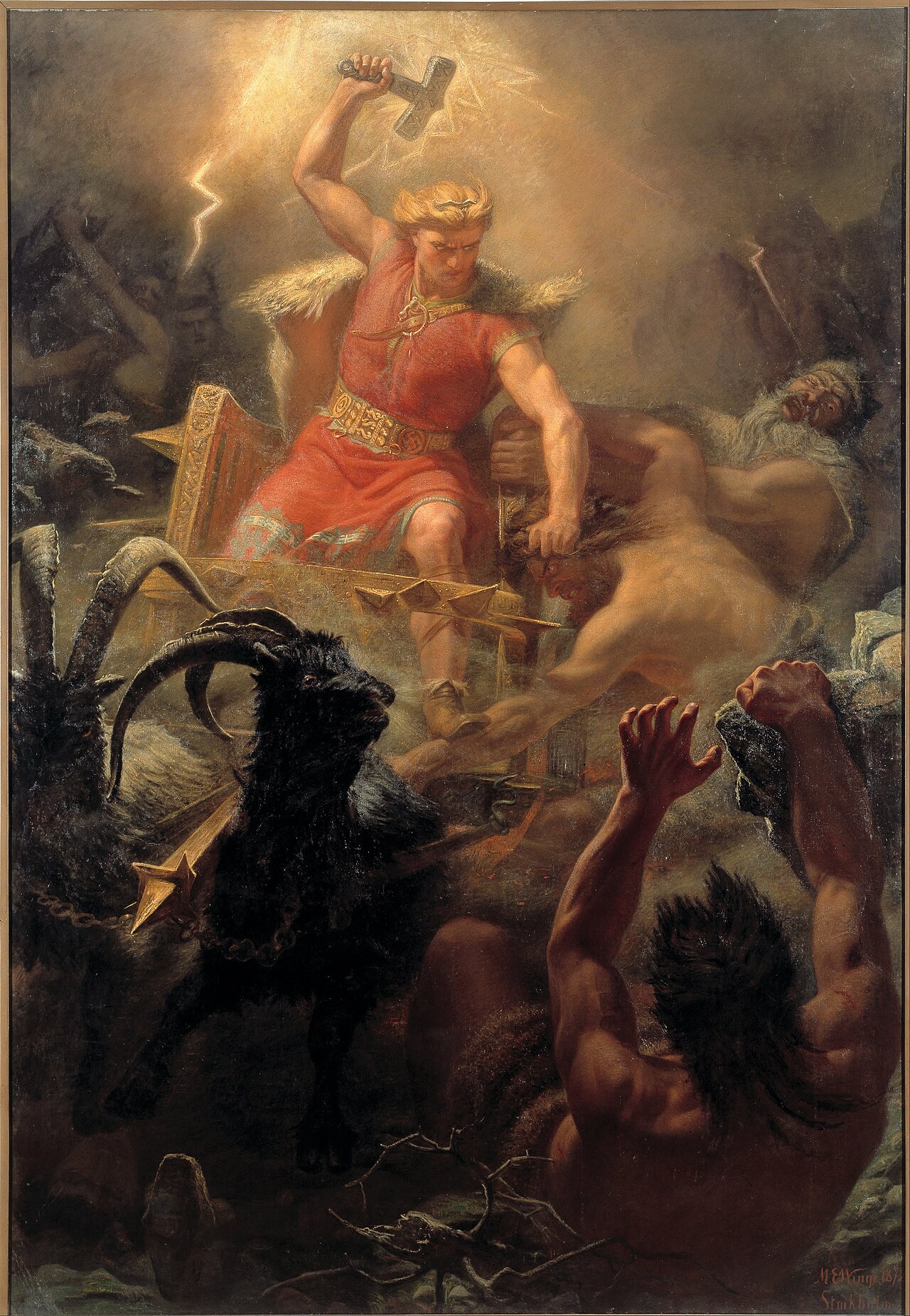
The sources describe Thor as large, powerful and quick to anger, with a big appetite and fierce eyes. Later Icelandic texts and much modern art give him a red beard, a detail discussed in its own post on this site. He travels in a chariot pulled by two goats, Tanngrisnir and Tanngnjóstr, which he can slaughter and eat in the evening and bring back to life the next morning by blessing their bones with his hammer.
His most important possession is Mjölnir, the short-handled hammer forged by dwarves, which returns to his hand after it is thrown. Snorri adds two more items: Megingjörð, a belt of strength that doubles his power, and a pair of iron gloves, Járngreipr, needed to grip the hammer. His hall in Asgard is called Bilskirnir, said to be the largest building ever made, and it stands in a region called Þrúðvangr or Þrúðheimr, meaning something like “fields of strength”.
Family connections
Thor is the son of Odin, the chief of the Æsir, and of Jörð, whose name simply means “earth”. His wife is Sif, a goddess known for her golden hair. He has a son, Magni, with the giantess Járnsaxa, and the sources also name a second son, Móði, and a daughter, Þrúðr. These relationships are covered in more detail in our post on Thor’s family tree.
The relationship people most often ask about is with Loki. In the myths, Loki is not Thor’s brother. He is a companion and sometimes a troublemaker who travels with Thor on several adventures and is described in one poem as Odin’s sworn blood-brother.
Key myths featuring Thor
A handful of stories are told again and again:
- The fishing trip with the giant Hymir, when Thor hooks the world serpent Jörmungandr using an ox head as bait.
- The theft of Mjölnir, told in the comic poem Þrymskviða, in which Thor dresses as the goddess Freyja to win his hammer back from a giant.
- The journey to Útgarða-Loki, where Thor and his companions are tricked by illusions in a series of contests.
- The duel with the giant Hrungnir, which leaves a piece of whetstone lodged in Thor’s head.
- His death at Ragnarök, when he kills Jörmungandr but takes nine steps and falls, poisoned by the serpent’s venom.
Thor in worship and daily life
Away from the literature, Thor’s popularity shows up in the physical record. Thor’s hammer pendants have been found across Scandinavia and in areas settled by Scandinavians, and many date to the 900s and 1000s, the period when Christianity was spreading. Some scholars suggest the pendants became more common partly as a visible counterpart to the Christian cross. Place names such as Torshälla in Sweden and Thorsager in Denmark, and personal names such as Thorstein and Thorgerd, point to the same popularity.
The English weekday Thursday also preserves his name, via Old English Þunresdæg, “Thunor’s day”. It is one of the clearest everyday traces of pre-Christian religion in the modern English language.
Reading the myths today
For anyone who wants to read the sources directly, several modern English translations of both Eddas are available, and older translations are in the public domain and free online. A useful habit is to note which source a story comes from, because details such as Thor’s family, his equipment and the order of events can differ between the poems and Snorri’s prose retelling.
It also helps to remember that Viking-age belief was not a single organised religion with a fixed scripture. Practice varied by region and century, and what survives is a partial snapshot recorded by later writers. Thor’s character is consistent across that evidence, though: a powerful, approachable protector who keeps the forces of chaos at bay, often with more strength than subtlety.
Discover more from Thor Stuff
Subscribe to get the latest posts sent to your email.