
Popular images of Viking warriors are often built around horned helmets, heavy fur and huge two-handed axes. The archaeological evidence suggests a different picture. This post looks at what is actually known about the protective equipment of Viking-age fighters, what has been found, and where the popular myths came from.
The horned helmet myth
There is no evidence that Viking warriors wore horned helmets in battle. No horned helmets have been found in Viking-age contexts. The idea became popular in the 1800s, especially through costume designs for Richard Wagner’s operas, including the costumes designed by Carl Emil Doepler for the first full performance of the Ring cycle in 1876. Romantic painters and later illustrators spread the image further.
Horned and winged helmets do exist from earlier periods in northern Europe, such as the Bronze Age Veksø helmets from Denmark, which are around 3,000 years old, more than a thousand years before the Viking age. These were probably ceremonial rather than for fighting.
The Gjermundbu helmet
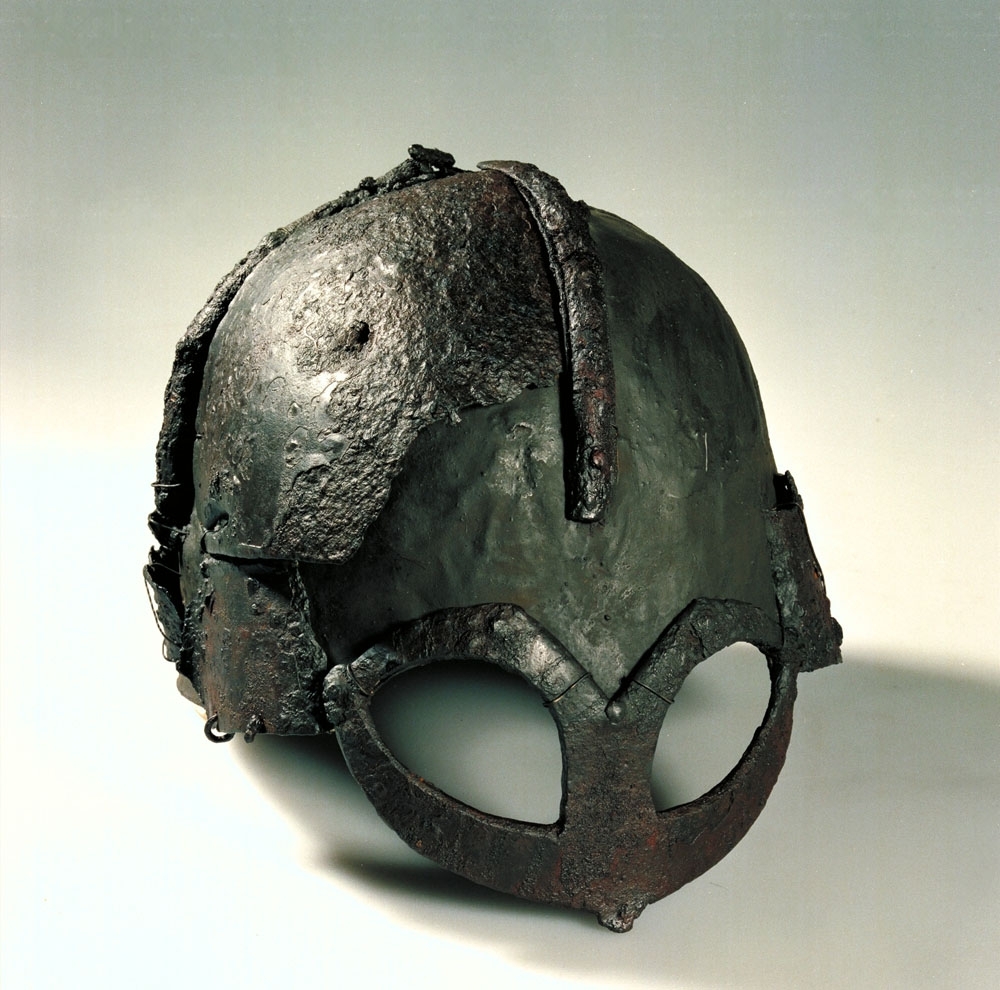
Remarkably, only one reasonably complete Viking-age helmet has been found in Scandinavia: the Gjermundbu helmet, discovered in 1943 in a burial mound at Gjermundbu in Buskerud, Norway, and now in the Museum of Cultural History in Oslo. It dates to the second half of the 900s. A photograph of it appears in this post.
The helmet is made of iron, with a rounded cap formed from several pieces riveted together and a spectacle-like guard protecting the eyes and nose. It probably had a mail curtain, called an aventail, protecting the neck. Fragments of other helmets have been found, but none are as complete. The rarity of finds suggests that iron helmets were expensive and not owned by every warrior.
Mail shirts
The best body protection available in the Viking age was the mail shirt, called a brynja in Old Norse. Mail is made from thousands of small interlinked iron rings. It was labour-intensive and costly to make, so mail was probably owned mainly by wealthier warriors. The Gjermundbu grave also contained fragments of mail, one of the few Viking-age finds of its kind in Scandinavia.
Mail shirts of the period were usually knee- or hip-length with short sleeves. Under them warriors probably wore padded garments to absorb impacts, though textile remains of this kind rarely survive.
Shields
The most common protective equipment was the round wooden shield. Viking-age shields were typically around 80 to 95 cm in diameter, made from planks of wood such as spruce, fir or pine, with a central iron boss to protect the hand. Some were covered with leather or rawhide and painted.
The Gokstad ship burial in Norway, from around 900, contained 64 shields, some painted yellow and black. Shields were also used in formations, and saga descriptions refer to a “shield wall” in battle.
Padded and leather armour
It is often suggested that ordinary warriors wore leather armour or padded jackets. Written sources and later evidence make padded garments plausible, but leather armour of the kind seen in films and reenactment is difficult to prove for this period, because leather and textiles rarely survive. Some scholars think hardened leather armour was uncommon. This remains an area of debate.
Lamellar armour, made from small overlapping plates laced together, has been found at Birka in Sweden. It is thought to reflect contacts with the east, possibly through warriors who had served in Byzantine or Central Asian contexts, and was probably not typical.
Arm and leg protection
There is very little evidence for Viking-age arm guards, greaves or bracers made of metal. Some items found in graves have been interpreted as protective, but they are rare and their purpose is uncertain. Many modern reenactment and costume pieces, such as leather bracers and studded arm guards, are inspired more by later medieval or fantasy styles than by Viking-age evidence. They can look good in costume, but they should not be mistaken for historical reconstructions.
Weapons and status
Weapons were tied to status. Spears and axes were common and relatively cheap. Swords were expensive, and the finest blades, such as those inscribed with the name ULFBERHT, were made from high-quality steel. A warrior’s equipment reflected his wealth: a well-equipped fighter might have a helmet, mail, sword, spear and shield, while a poorer one might have only a spear, an axe and a shield.
Reconstructing Viking armour
Reenactors and museums today reconstruct Viking-age equipment using the surviving evidence, sometimes filling gaps with informed guesses. Good reconstructions are usually based on specific finds, like the Gjermundbu helmet or the Gokstad shields. Anyone buying replica equipment can ask what original find it is based on, which is a quick way to separate historical reproductions from fantasy designs.
The takeaway
Viking warriors were well equipped by the standards of the time, but their armour was practical rather than theatrical. Iron helmets were simple and rare, mail was valuable, and most fighters relied above all on a wooden shield. The horned helmets and elaborate armour of popular culture tell us more about 19th-century imagination than about the Viking age.
Where to see original equipment
The Gjermundbu helmet and mail are displayed at the Museum of Cultural History in Oslo. The Gokstad ship and its finds are in the same museum’s collections. The Swedish History Museum in Stockholm holds material from Birka, including weapons and lamellar fragments, and the National Museum of Denmark has a wide range of Viking-age weapons. Many of these museums publish photographs of their collections online, which are a reliable starting point for anyone researching historical equipment.
Discover more from Thor Stuff
Subscribe to get the latest posts sent to your email.